

When “Seatbelt Tech” Doesn’t Click
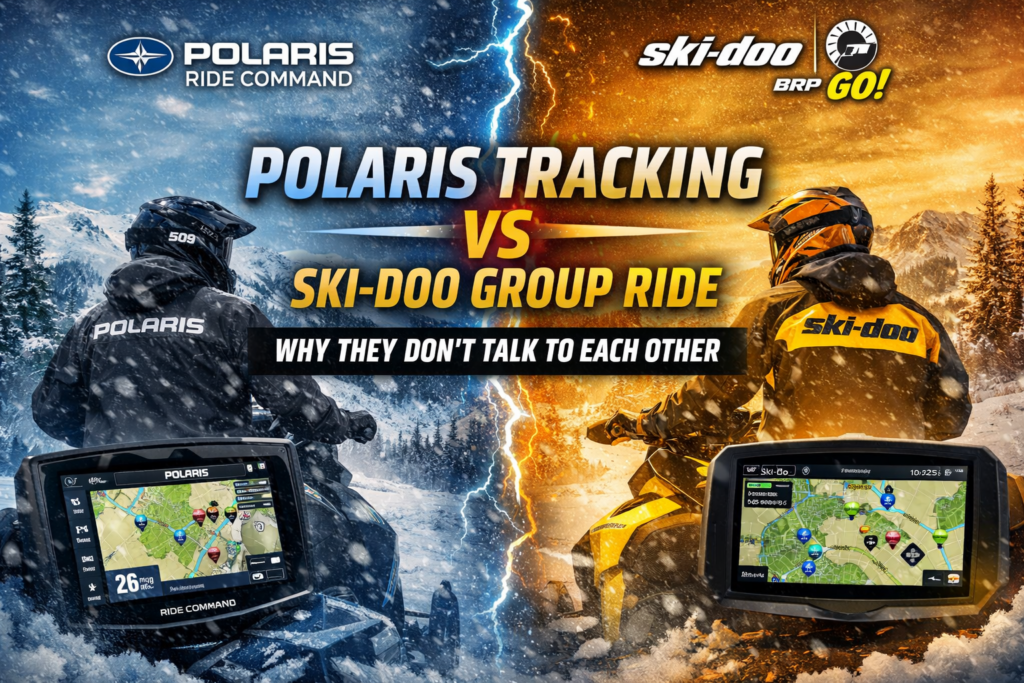
Polaris Tracking vs. Ski-Doo Group Ride and Why They Don’t Talk to Each Other
Snowmobiling keeps getting smarter. Displays are brighter, maps are better, and “where’s my crew?” is increasingly a tap away. Polaris riders lean on RIDE COMMAND / Group Ride. Ski-Doo riders lean on BRP GO! / Group Ride. Both are aiming at the same outcome: reduce separation risk, speed up regrouping, and add peace of mind – the way a seatbelt became a non-negotiable safety baseline in cars.
So why can’t a Polaris “Buddy” show up on a Ski-Doo map (and vice versa)? And if they can’t communicate, then what does that mean for the future of snowmobiling?
Let’s explore this from a rider-first perspective while giving credit to the engineering on both sides.
What each system is actually doing:
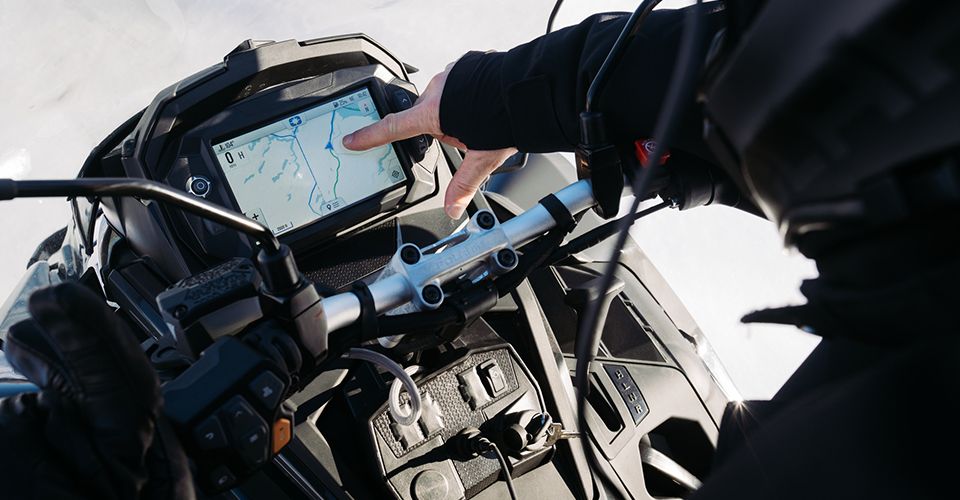
Polaris: RIDE COMMAND + Group Ride (and Group Ride+)
At a high level, Polaris offers group location sharing in a couple of ways depending on hardware and setup:
- Phone/cellular-based Group Ride: Polaris’ help guidance describes Group Ride via the 7S display using a phone connection, where range is essentially “as far as you have service,” because it relies on mobile connectivity.
- Vehicle-to-vehicle (V2V)-style Group Ride (off-road example): Polaris documentation for off-road 7″ displays describes Group Ride using V2V communications with ~1+ mile range and messaging between vehicles.
- Group Ride+ / RIDE COMMAND+ add-ons: Polaris also describes “Group Ride+” as a feature tied to a RIDE COMMAND+ plug-in and subscription (i.e., more connectivity options enabled through Polaris’ ecosystem).
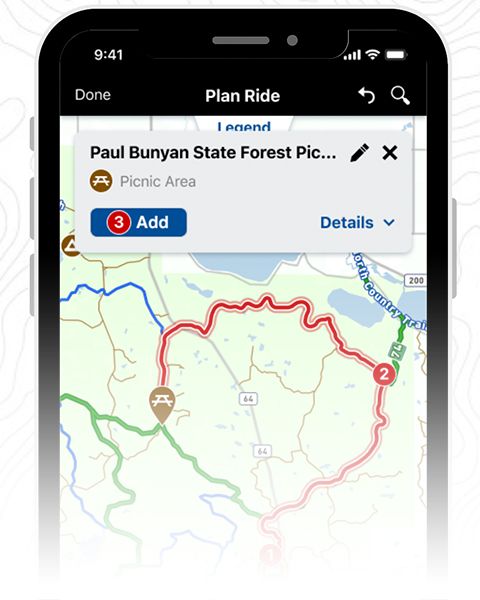
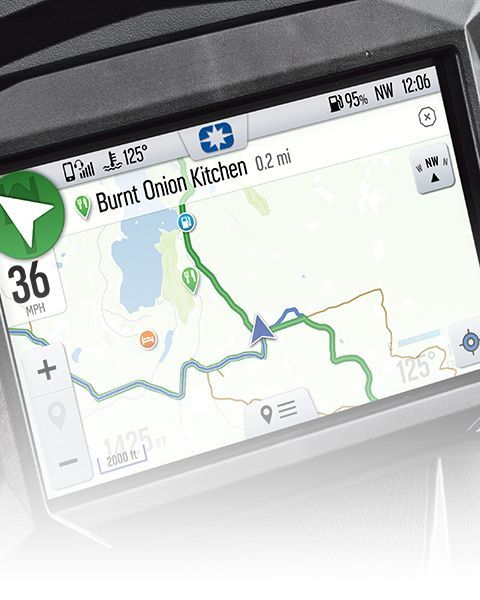
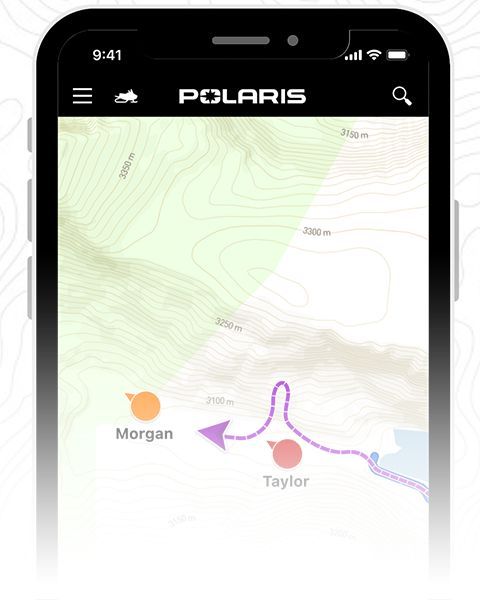
The important takeaway: Polaris Group Ride is built around Polaris’ own identity system (Polaris accounts), apps, and/or specific hardware connectivity paths.
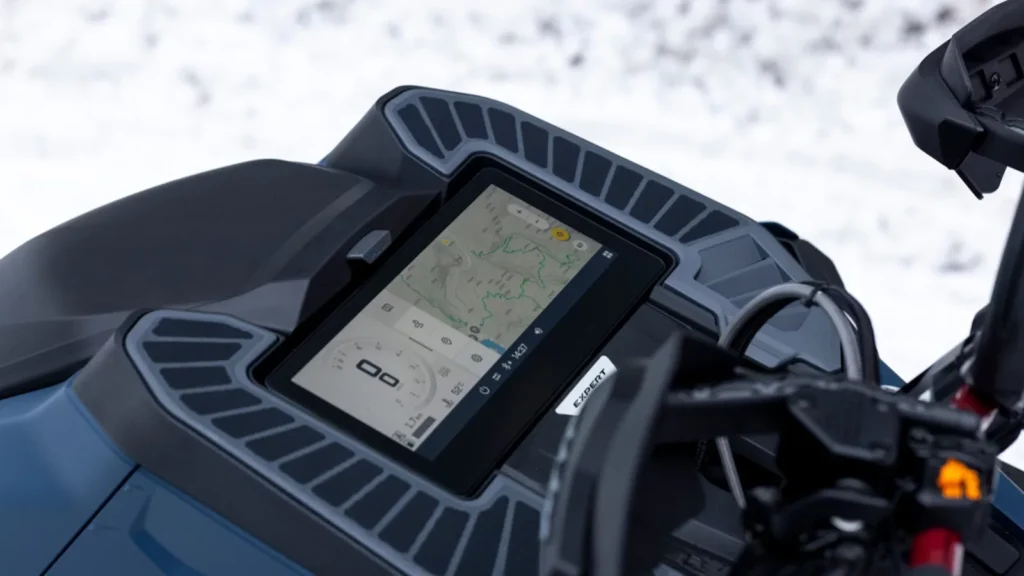
Ski-Doo: BRP GO! + Group Ride (and the 10.25″ Built-in GPS feature)
BRP GO! is Ski-Doo/BRP’s connected navigation/social layer:
- For 2026 models equipped with the 10.25″ touchscreen display, Ski-Doo integrates Group Ride directly into the built-in GPS system.
- Riders can add friends, create groups, and follow each other on a live map all from the sled’s display interface.
- Most notably, 2026 models introduced offline live location sharing, with short-range connectivity of approximately 1+ mile depending on terrain. That means riders can maintain visibility of their group even when cellular service disappears – a meaningful step forward for backcountry and remote riding environments.
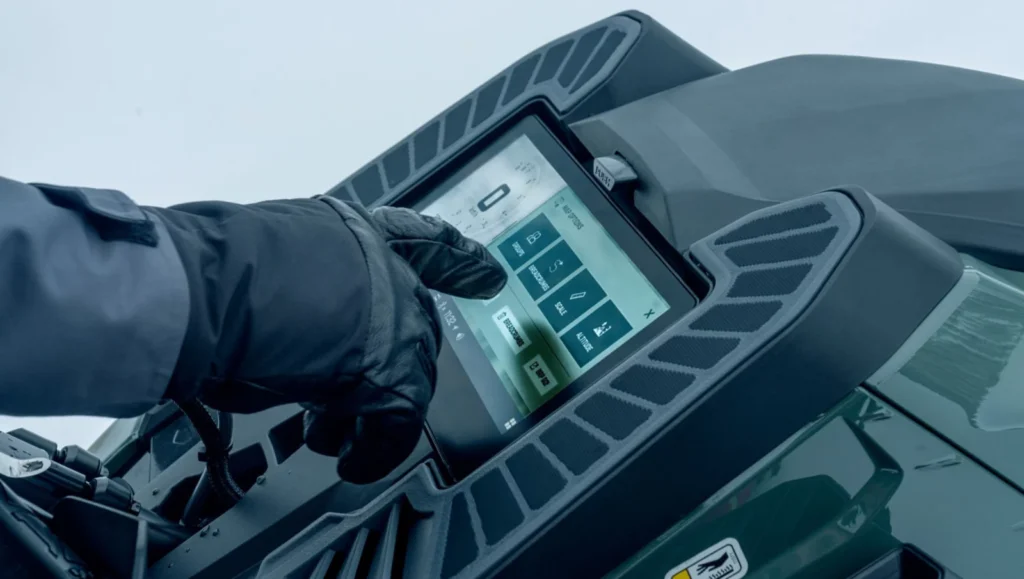
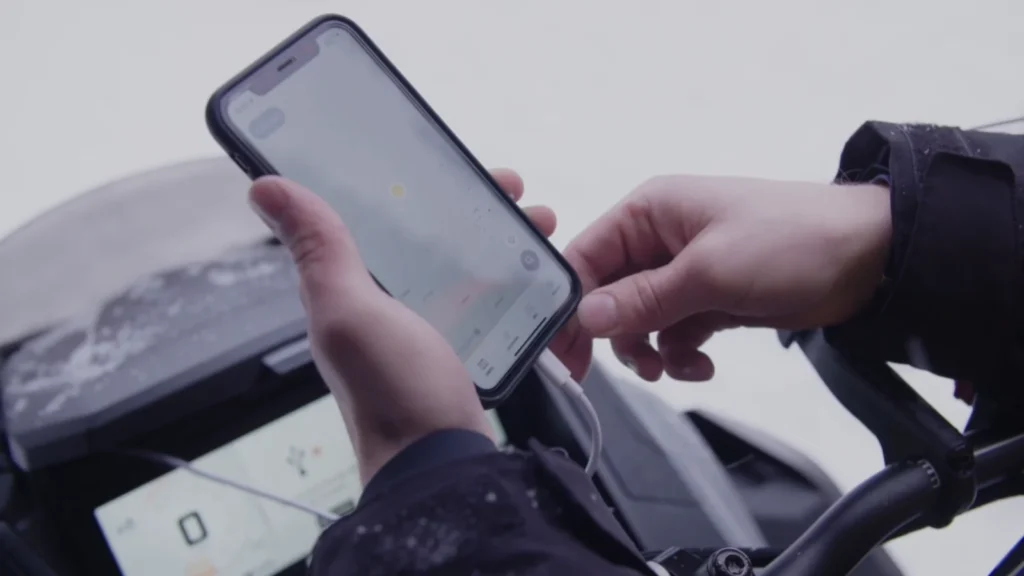
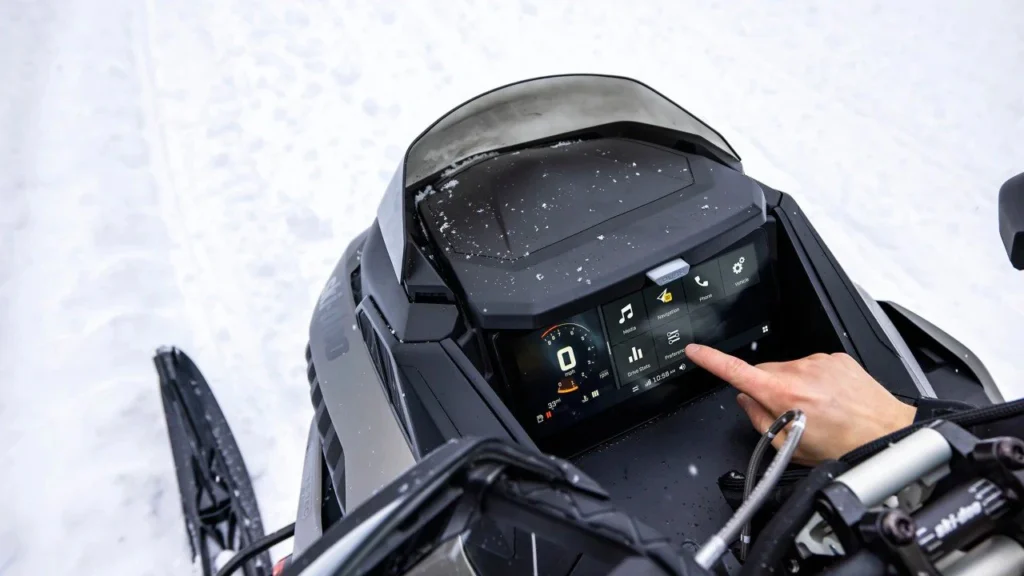
The important takeaway: BRP GO!/Group Ride is also built inside BRP’s own account/app/display ecosystem—and (depending on model year and configuration) may be cellular-dependent or capable of short-range offline sharing.
So why they can’t communicate with each other?
1) They’re different “networks,” not just different apps
To a rider, this feels like “two map apps should just share dots.” But in practice, these are closed ecosystems:
- Polaris Group Ride is designed to work with the Polaris App powered by RIDE COMMAND and Polaris’ backend rules for groups and sharing.
- Ski-Doo’s BRP GO! does friend/group tracking inside BRP GO!’s own friend and group system.
Even if both are “GPS pins,” the systems still need a shared way to:
- identify users (accounts)
- authorize who can see whom (privacy/permissions)
- transport the location updates (cellular cloud vs. short-range V2V/peer-to-peer)
- render them consistently on maps
Without a shared standard, they’re like iMessage and WhatsApp: both do messaging, but they’re not the same network.
2) Communication method mismatch (cloud vs. short-range vs. hybrid)
From the sources above, you can see two different technical realities:
- Some group tracking modes are cellular/cloud-based (infinite range if you have service). Polaris describes this model directly for Group Ride via a phone connection.
- Some modes aim at offline/short-range sharing (around a mile+), like Ski-Doo’s 2026 built-in GPS Group Ride description.
Even if both brands offer a “1+ mile” style experience, they still might be using different radios, pairing methods, encryption, and message formats.
3) Safety + liability + privacy are not “bonus features” – they’re design constraints
The moment you share real-time location, you’re handling:
- consent (who can see you)
- retention (does the system store history?)
- emergency expectations (“if it shows I’m moving, does that mean I’m okay?”)
- failure cases (“if it drops, who’s responsible?”)
Those constraints make brands cautious about opening their systems to third parties, especially direct competitors, unless there’s a strong industry framework and shared legal/technical standards.
4) Business reality: ecosystems create loyalty
This is the uncomfortable truth: connectivity features can be a reason someone buys a particular sled brand, display package, or subscription. Polaris explicitly markets RIDE COMMAND+ as added peace of mind and “next-level…connectivity.”
BRP markets BRP GO! as a “connected riding experience” with friend locating and route features.
Interoperability is possible – but it’s a strategic decision, not just an engineering sprint.
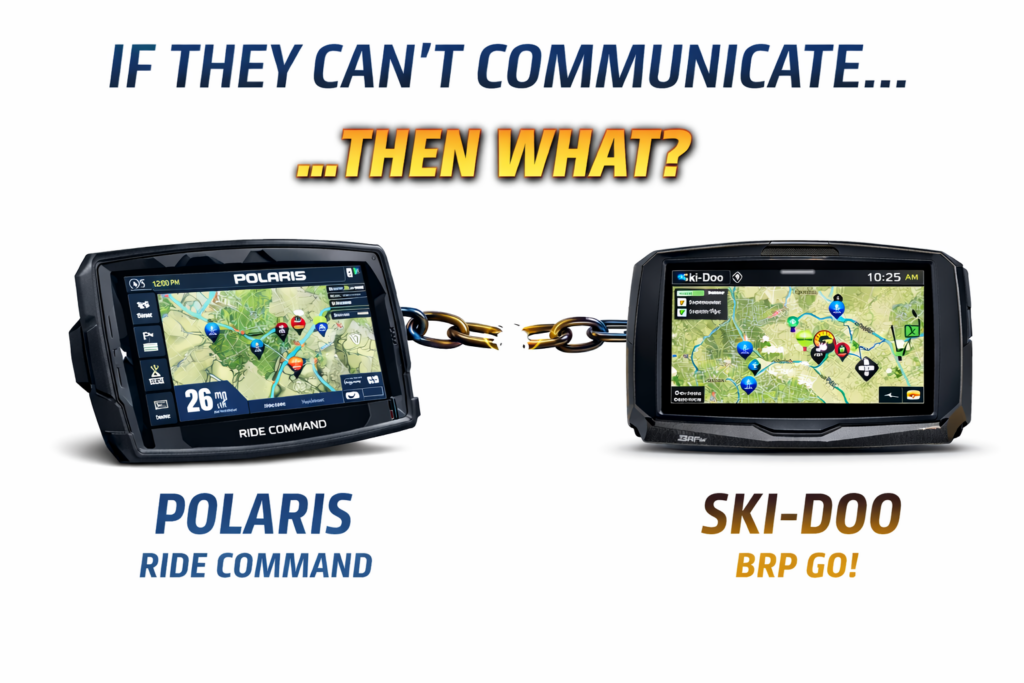
Here’s the blunt rider reality:
A tracking feature that only works inside your brand bubble is helpful, but it’s not a full “seatbelt” for the sport.
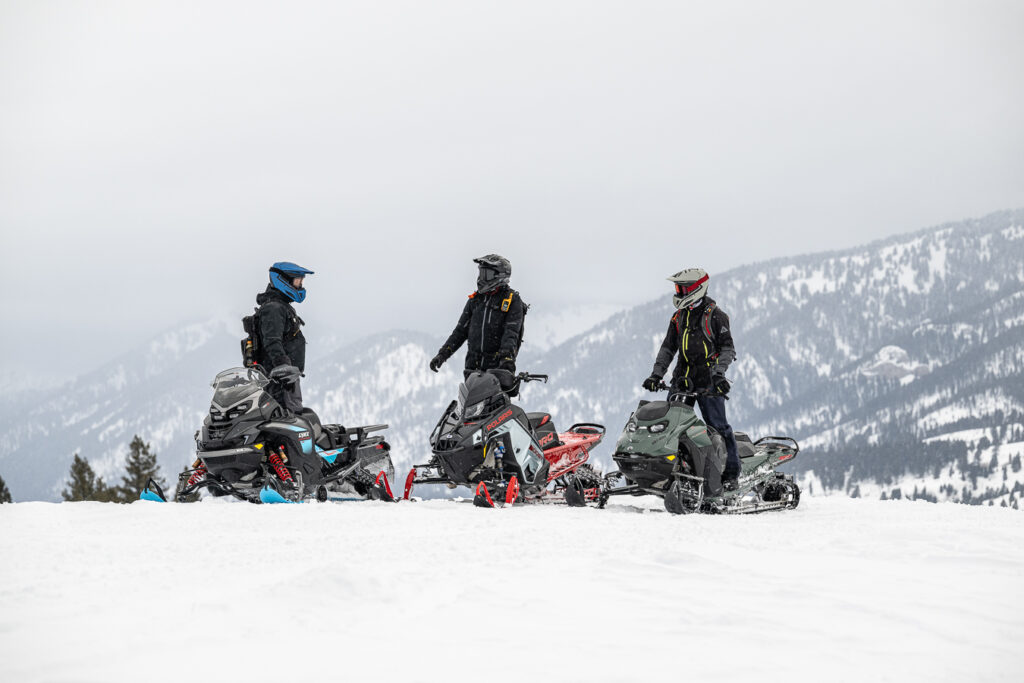
Because risk doesn’t care what logo is on your hood. Mixed-brand groups are normal:
- families with different sleds
- rentals + personal sleds
- rescue situations
- riding buddies who’ve switched brands over time
So if cross-brand dots aren’t on the table today, the practical answer is to stack safety layers.
Alternative solutions riders can use right now (mixed-brand friendly)
1) Satellite messengers (the real backcountry baseline)
If you ride where cell coverage disappears, a satellite SOS/communicator is the closest thing to a “universal seatbelt.” It doesn’t replace group tracking, but it covers the worst-case scenario: you need help, now.
2) Off-grid mesh messaging + location sharing
Products and open ecosystems that create a phone-to-phone mesh (no cell towers) can help groups share locations/messages regardless of brand, because the sled brand becomes irrelevant.
3) Radios (simple, and reliable)
A good radio doesn’t show a dot on a map, but it can prevent a separation incident from becoming a search.
4) Old-school discipline (still undefeated)
- ride plan + check-in points
- designated sweep/lead
- “last seen” rule at every intersection
- regroup timing rules in trees or alpine
Tech is a layer. Process is the foundation.
What the future of snowmobiling could look like because of this
If riders keep asking for this “seatbelt feature,” the future likely splits into three paths:
Path A: Brand ecosystems get stronger, but still siloed
Each brand improves its own “offline group ride,” range, and reliability, but mixed-brand groups still need a workaround.
Path B: A shared industry standard emerges (the best outcome)
Imagine an open, safety-only interoperability layer:
- a universal “show my location to my group” protocol
- brand apps keep their premium features, maps, subscriptions, and UI
- but the basic safety dot is cross-compatible
That’s how a lot of vehicle safety tech evolves: shared standard first, brand differentiation on top.
Path C: Smartphones + OS-level safety sharing becomes the bridge
As phone emergency and location-sharing tools improve, sled displays may become the “viewer,” while the phone (or satellite device) becomes the universal transmitter.
A rider-first challenge (that also benefits brands)
Here’s a constructive way to frame it to the industry:
Make the minimum viable safety feature universal, and let everything else compete.
- Universal: “share my live location with my group” + last known point + timestamp + consent controls
- Competitive: maps, trail data, ride stats, UI, subscriptions, POIs, route planning, integrations, vehicle telemetry
That approach:
- improves safety outcomes for everyone
- reduces brand blame when riders discover “it doesn’t work with my buddy”
- builds trust (which sells sleds, accessories, and premium connectivity long-term)
Snowmobiling is evolving fast. Polaris and Ski-Doo are both pushing meaningful innovation forward, and that deserves recognition. But as technology becomes part of our safety culture, we have to ask a bigger question: are we building better brand ecosystems, or a safer sport? Until cross-brand visibility exists, riders must take responsibility for layered safety because the mountain doesn’t recognize loyalty badges. And if group tracking truly becomes the seatbelt of snowmobiling, then the next evolution won’t just be smarter screens, it will be shared standards that protect every rider, no matter what they ride.