GoPro vs. Insta360 vs. DJI: Choosing the Right Action Camera for Snowmobiling – Roundtable
Three experienced action sports filmmakers and riders compare camera systems, mounting options, software and what really matters when capturing snowmobile footage.
Action cameras have become an essential part of documenting mountain snowmobiling. Whether it’s a helmet-mounted POV camera, an unusual angle from the sled or a 360-degree shot, these small cameras can capture perspectives that would otherwise be difficult or impossible to film.
But choosing which camera to buy has become increasingly complicated.
GoPro, Insta360 and DJI are all competing for the action camera market, offering increasingly capable cameras with different features, accessories and software ecosystems. With improvements in image quality, stabilization, audio and recording formats, deciding which brand offers the best system isn’t necessarily straightforward.
Mountain Sledder’s Tim Grey recently brought together three experienced action sports filmmakers and riders to discuss the options: Blaine LeBlanc, Brett Turcotte and Mike Reeve.
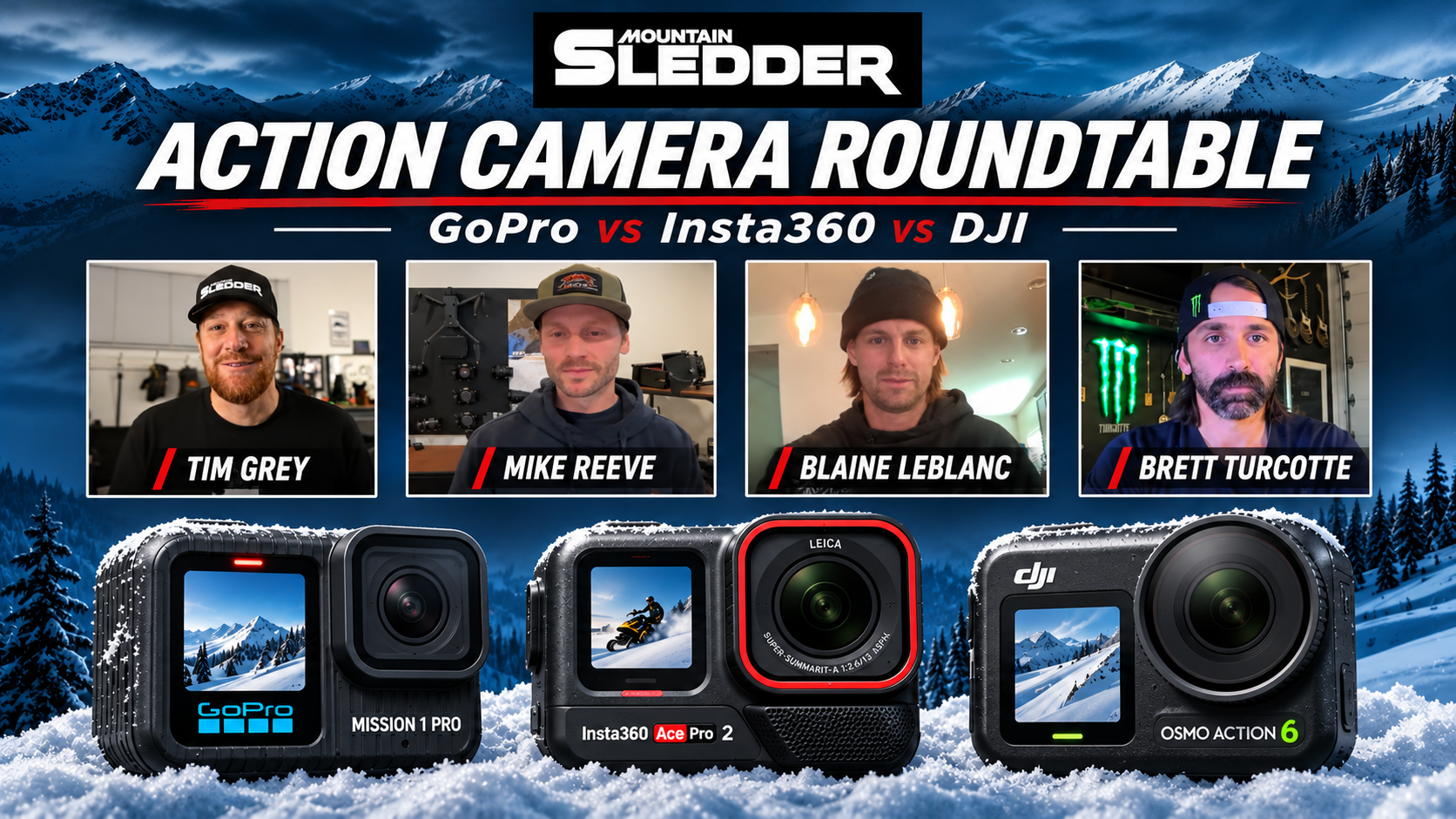
LeBlanc is a professional action sports cinematographer who has worked extensively with Red Bull, Nitro Circus and other major productions. He regularly rigs multiple GoPros on everything from race vehicles to helicopters.
Turcotte is a 10-time X Games medalist and Polaris athlete who has spent years recording POV footage. More recently, he has become increasingly involved in producing his own videos, using Insta360 cameras as part of his everyday filming setup.
Reeve is a veteran mountain sledding filmmaker with a long history shooting Slednecks projects and working with brands including 509. His experience spans professional camera equipment, action cameras and the practical challenges of producing content in the backcountry.
Together, they bring three different perspectives on what makes an action camera system worth investing in.
It’s About More Than Camera Specifications
The discussion began with Grey looking to replace his aging GoPro HERO9. While the camera has served him well, its footage has become more difficult to match with the images coming from his newer professional cameras.
That raised a larger question: should buyers evaluate individual cameras or consider the entire ecosystem surrounding them?
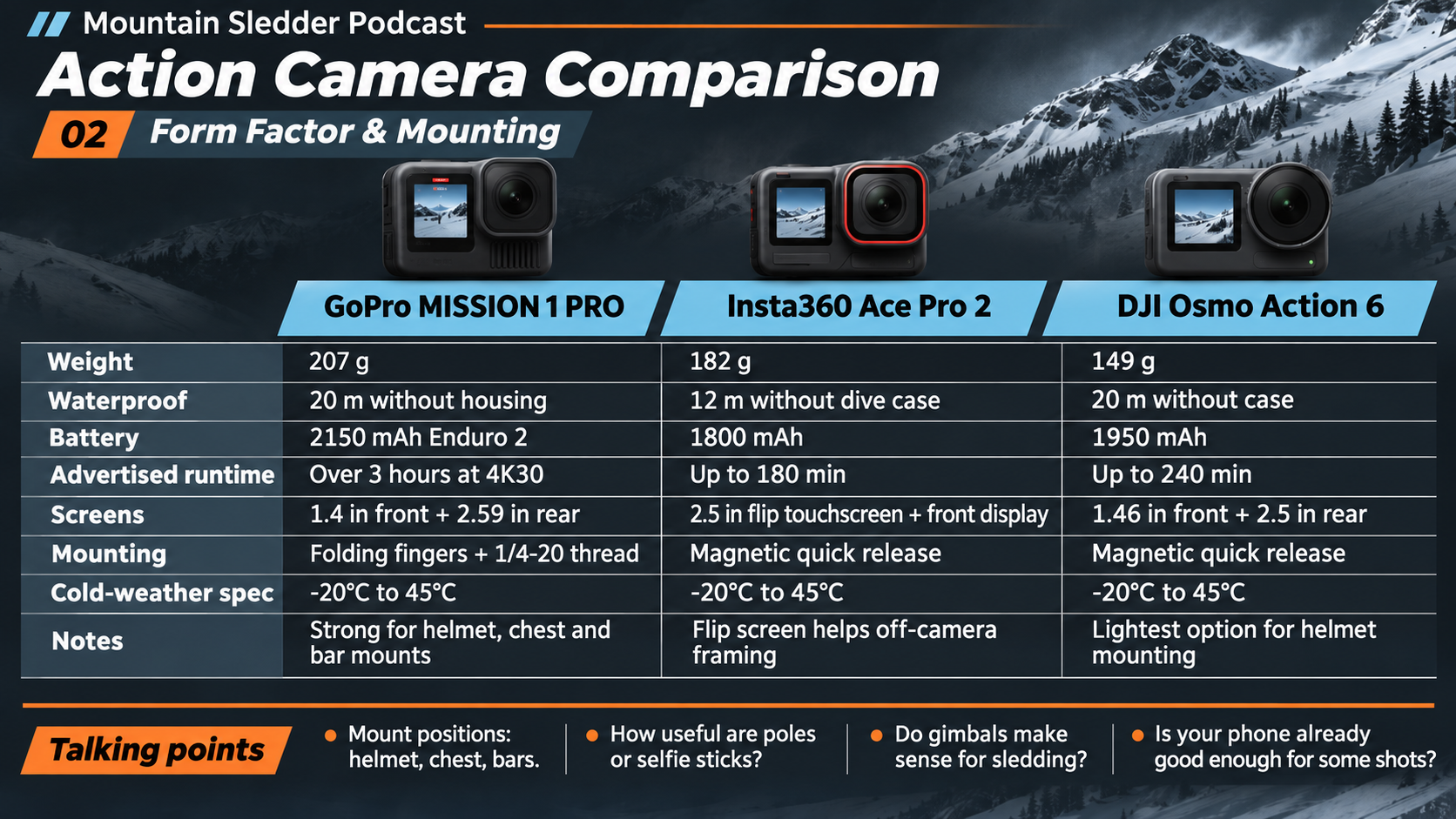
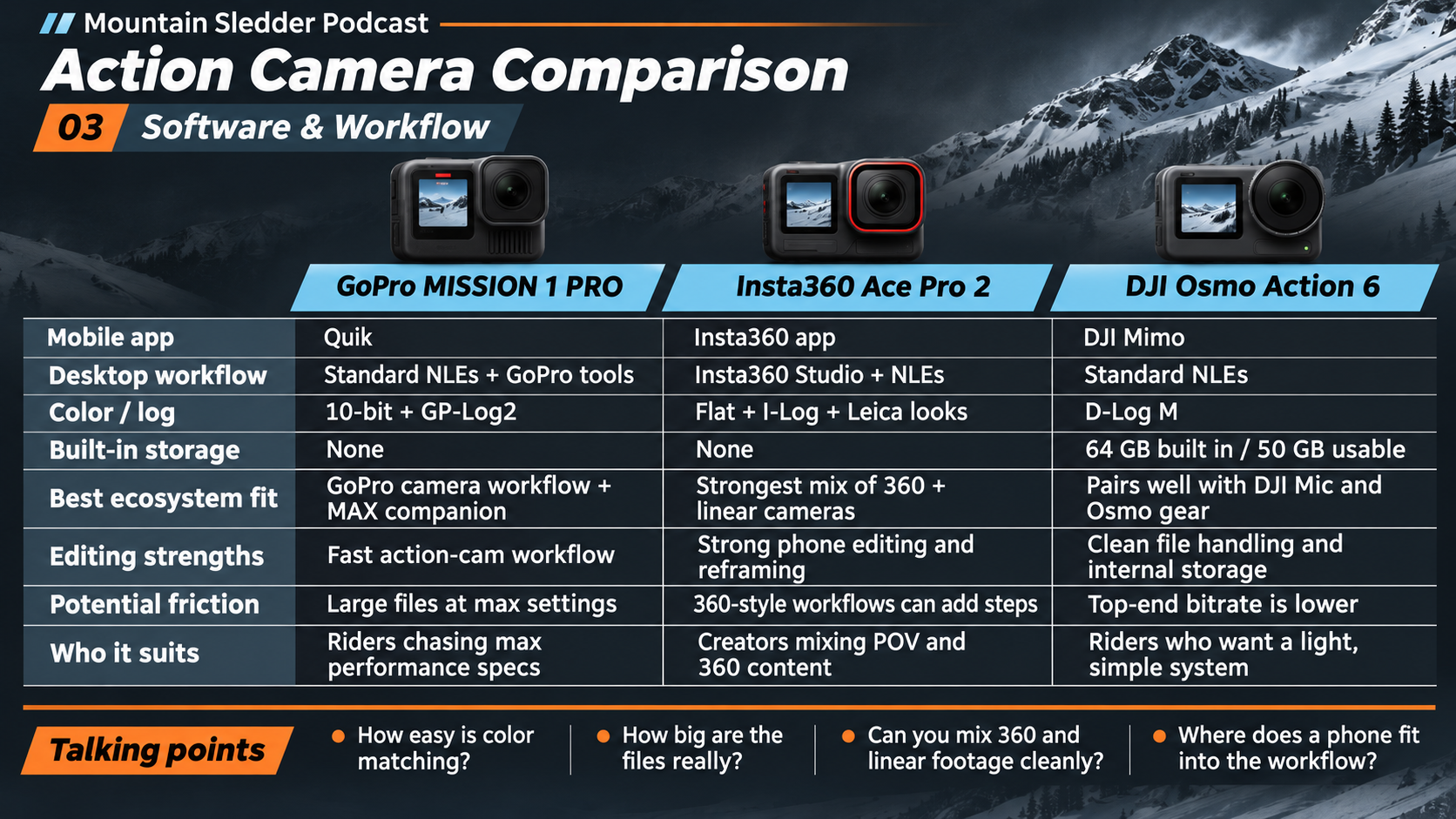
The group approached the comparison through three categories: specifications, form factor and software.
Resolution, frame rates and sensor sizes are important, but so are mounting options, battery performance, wireless microphones, editing software and how easily everything works together.
For a professional filmmaker, the ability to colour-match several cameras or synchronize footage may be a major consideration. For a sledder who wants to record a day in the mountains and share a few clips afterward, simplicity and convenience might matter considerably more.

GoPro: Professional Production and Camera Control
LeBlanc has built much of his professional workflow around GoPro. He sometimes operates dozens of cameras on a single production, making reliability, consistent settings and synchronization particularly important.
He demonstrated how GoPro Labs allows him to manage camera settings using QR codes, making it possible to configure multiple cameras quickly. Synchronizing timecode across cameras also simplifies editing footage from multiple angles.
LeBlanc also introduced the GoPro MISSION 1 PRO and the MISSION 1 PRO ILS, the latter using an interchangeable-lens system.
The ILS represents a different approach to action camera filmmaking. With interchangeable Micro Four Thirds lenses, adjustable focus and aperture, filmmakers can capture images that would traditionally require a larger camera system.
However, the additional lenses, weight and mounting requirements make it a more specialized production tool rather than an obvious replacement for a conventional helmet camera.
For LeBlanc, the appeal is having different cameras that can operate within a familiar workflow.
Insta360: A Practical Setup for Riders and Content Creators
Turcotte’s approach is considerably different.
His everyday camera is the Insta360 Ace Pro 2, mounted beneath his helmet visor. He has refined the setup to the point where operating it has become a routine part of his riding.
The camera’s magnetic mounting system allows him to remove it quickly, while its flip-up screen makes it useful for filming himself and other activities away from the sled.
Turcotte also values the ability to pair wireless microphones with the camera, allowing him to record commentary while riding.
Cold-weather battery performance has been another important consideration. During the roundtable, the group recalled occasions when Insta360 cameras continued recording in cold conditions after other equipment had exhausted its batteries.
Turcotte carries a compact case containing his cameras, batteries and audio equipment. For someone who regularly produces his own content, having a portable system he knows how to operate is a major advantage.
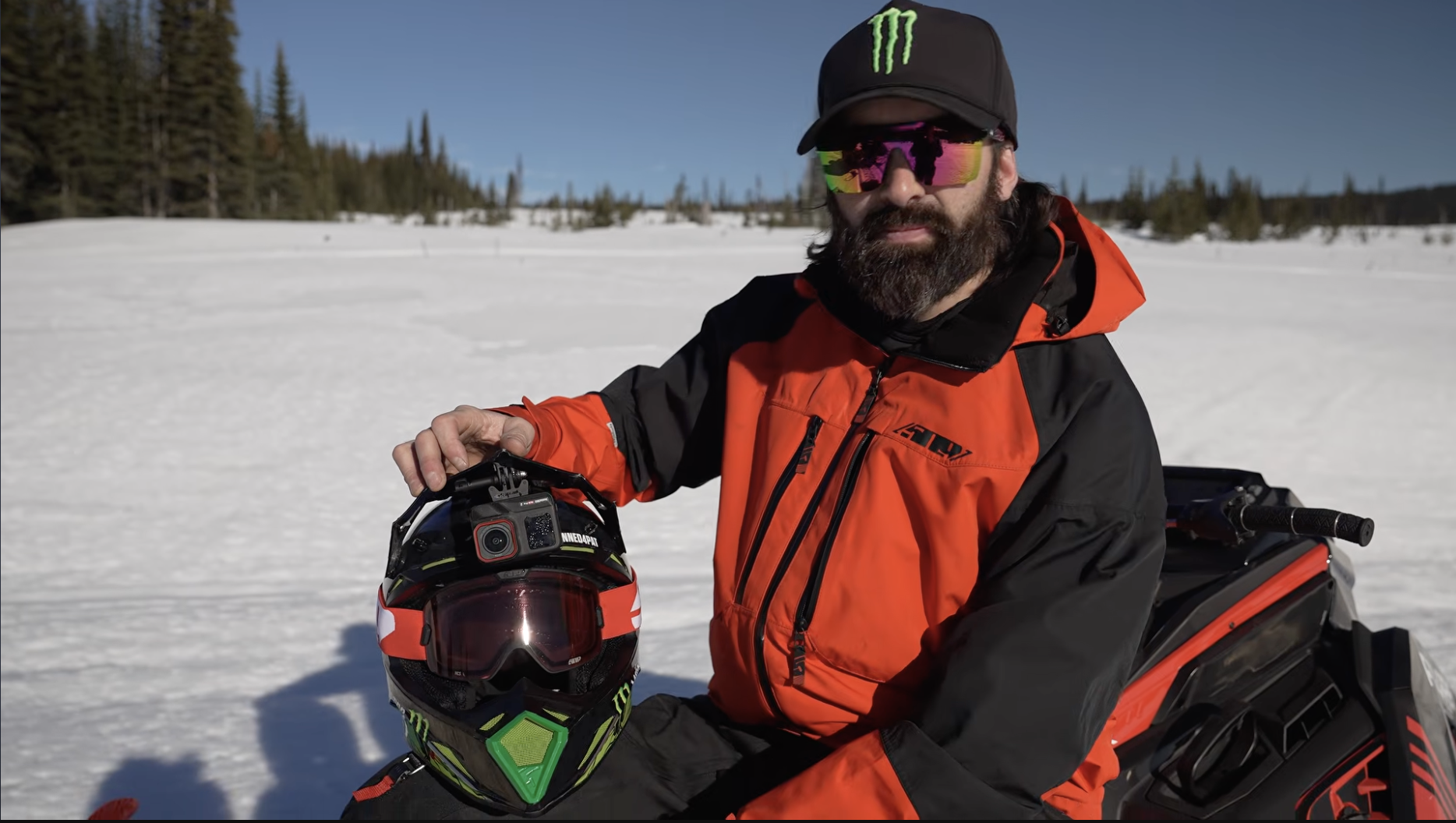
Turcotte with his Insta360 Ace Pro 2
DJI: The Benefits of an Integrated System
Reeve explained that his move toward DJI wasn’t primarily driven by resolution or other headline specifications.
During a recent production in Chile, his crew was already using DJI wireless microphones with its main cameras. The ability to integrate those microphones with DJI action cameras made the system particularly attractive.
For backcountry filmmakers, reducing the number of accessories, receivers, adapters and batteries can make a substantial difference.
The DJI Osmo Action 6 also offers adjustable aperture, although Reeve suggested that feature wasn’t the deciding factor for his work.
Grey raised a similar consideration. Already using DJI drones, microphones and other equipment, he sees a potential advantage in choosing an action camera that fits into the gear he owns.
It’s an important point for anyone investing in multiple cameras: the best individual camera might not necessarily be the best addition to an existing filming system.
Comparing the Cameras
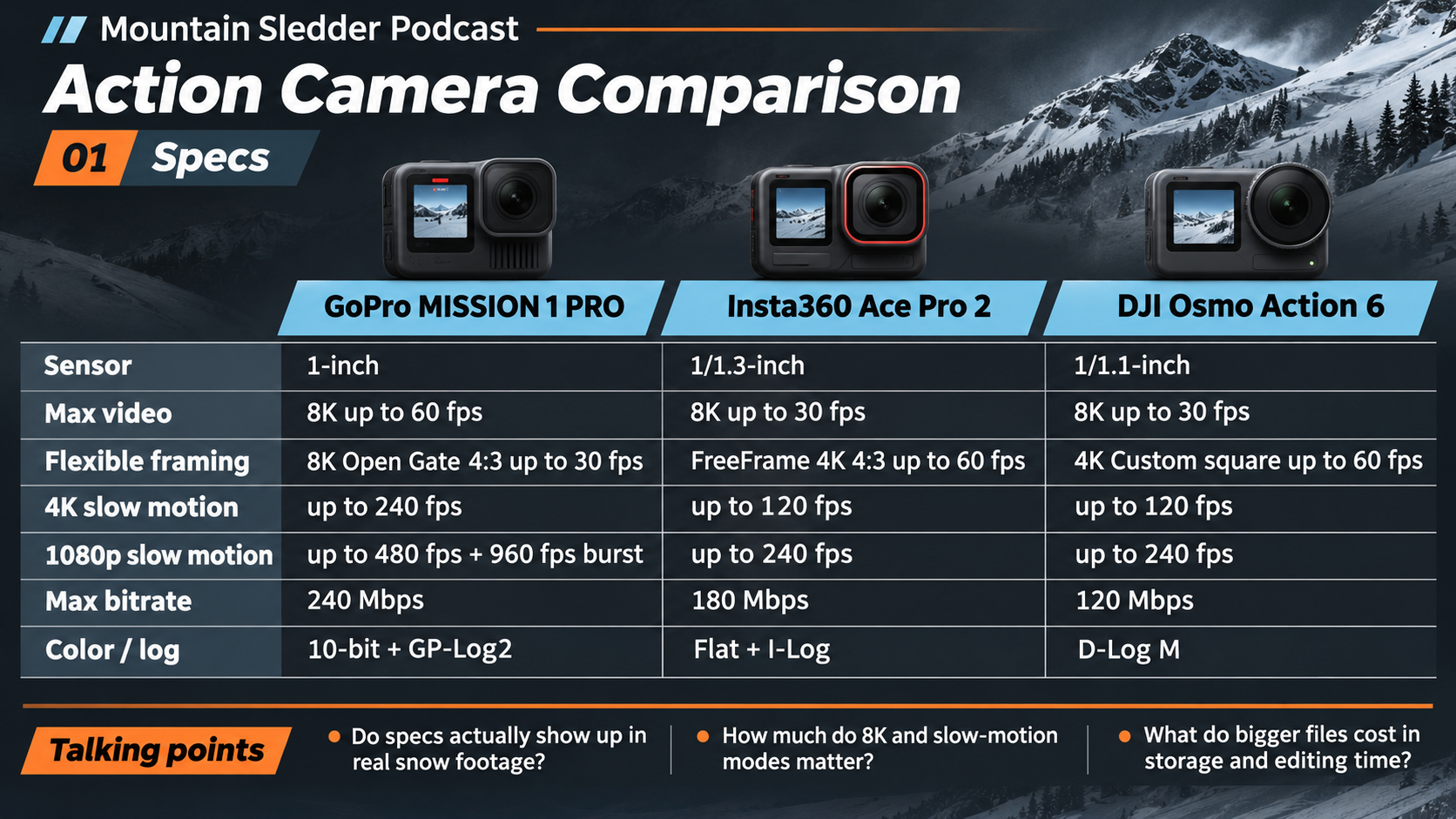
We prepared three comparison graphics covering the primary considerations discussed during the roundtable.
Camera specifications — Resolution, sensor size, frame rates, recording formats and other technical capabilities.
Should You Buy a 360 Camera?
One of the more useful parts of the conversation dealt with 360-degree cameras and whether they should replace conventional action cameras.
All three guests recognized the creative opportunities offered by 360 footage.
With a single recording, an editor can select multiple perspectives, follow a rider through a shot or create camera movements that would otherwise require an operator.
Turcotte uses 360 cameras selectively, particularly when he’s attempting something significant or wants to capture a different perspective.
However, he doesn’t recommend recording an entire day of regular riding exclusively in 360.
The files can be substantial, and reframing footage creates additional editing work. While the software has improved, processing hours of 360 footage is considerably more involved than working with conventional POV clips.
For most sledders, a traditional action camera remains the more practical everyday option, with a 360 camera serving as an additional creative tool.
Frame Rates, Stabilization and the Look of POV Footage
The conversation also covered some practical settings that can make a difference in how footage looks.
Turcotte generally records his everyday POV footage at 4K and 24 frames per second. For footage he intends to slow down, he switches to higher frame rates, including 60 fps for 360 recordings.
LeBlanc discussed the advantages of recording at higher resolutions, particularly the ability to crop into footage while maintaining image quality.
Interestingly, the group also questioned whether maximum image stabilization is always desirable.
Modern cameras can produce remarkably smooth footage, but that isn’t necessarily the best way to communicate the speed and intensity of riding a snowmobile.
LeBlanc explained that he sometimes records without stabilization to preserve the movement and vibration experienced by the rider. Turcotte also pointed to the effectiveness of using minimal stabilization when trying to convey speed.
It’s a useful reminder that the most technically polished image isn’t always the most effective one.
The Best Footage Isn’t Necessarily Shot on the Newest Camera
Late in the conversation, Turcotte revisited one of his most memorable snowmobile POV clips, filmed in 2013 using an early GoPro.
The footage showed him dropping into a steep, narrow chute. More than a decade later, it remains one of his favourite POV shots.
Turcotte also recounted how the clip helped get him noticed by Monster Energy and ultimately contributed to securing a sponsorship.
It’s an example of something that came up repeatedly throughout the roundtable: memorable footage depends on the moment being captured, not simply the equipment recording it.
Today’s action cameras offer capabilities that would have been difficult to imagine when those early GoPros appeared. But understanding how to mount a camera, selecting useful settings, keeping batteries charged and recognizing a worthwhile shot remain just as important.
None of the guests declared a definitive winner between GoPro, Insta360 and DJI.
Instead, the discussion highlighted why each has found a system that works for his particular needs.
For anyone considering a new action camera, the advice is to think carefully about how it will actually be used. A professional cinematographer managing multiple cameras has different requirements from an athlete producing YouTube videos or a recreational sledder recording trips with friends.
And if you already own a working action camera, there may be more value in learning to use it effectively before replacing it.
—